Indoor Air Quality During Haze in Singapore and Malaysia: Understanding the OH-FEEL® 500 Series
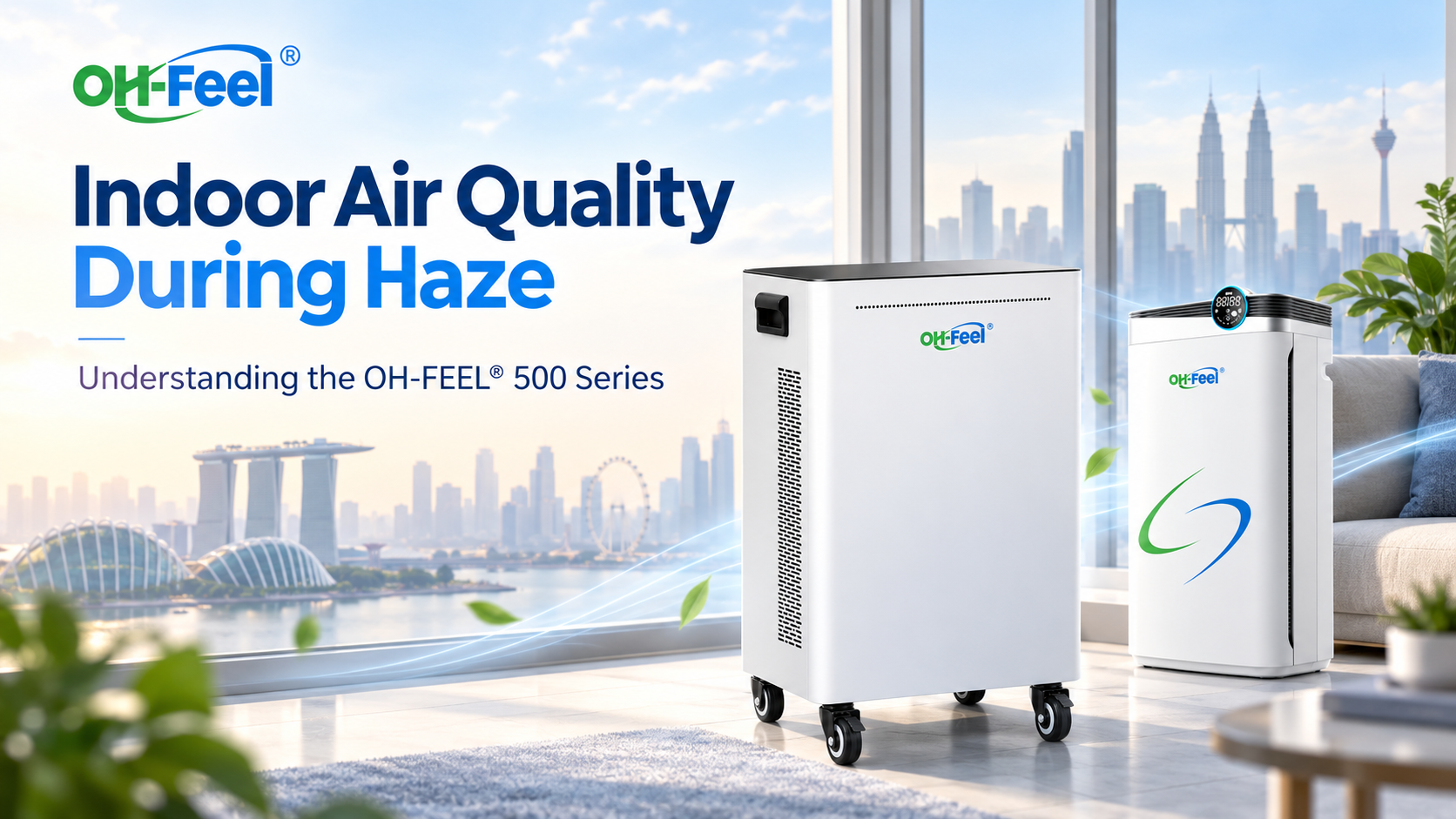
Haze Is One Part of Indoor Air Quality
For homes and businesses in Singapore and Malaysia, haze brings fine-particle exposure into focus. Choosing an indoor air-treatment system also requires understanding gaseous pollutants and airborne microorganisms. These are different treatment targets, and a result for one should not be presented as proof of performance against the others.
Singapore’s National Environment Agency advises that highly efficient filters, such as HEPA filters, are preferred for fine-particle removal. Its guidance also highlights room size and smoke clean air delivery rate (CADR), or supporting fine-particle removal information from the manufacturer, when choosing an air purifier for haze.
This distinction matters: formaldehyde or TVOC reduction is not a substitute for verified fine-particle performance, and laboratory microbial results do not establish protection against infection in everyday use.
Three Models in the OH-FEEL® 500 Series
The OH-FEEL® 500 series includes OH500F08-01, OH500CD04 and OH500A. OH-FEEL® has confirmed that the referenced report data may be shared across these three 500-series models because they use the same hydroxyl module. This model correspondence is based on manufacturer confirmation; it should not be described as three separately identified laboratory tests unless the original reports establish that.
Shared module-based data do not mean every model has the same airflow, power consumption, noise level or room-size specification. Customers should compare the operating specifications of the particular model they intend to use.
What the Supplied Formaldehyde and TVOC Report Shows
A results page from Guangdong Detection Center of Microbiology carries report reference 2018FM12289R02. The page states that testing took place in a 30 m³ test chamber. Concentrations were measured at the start and after one hour, with a separate blank-chamber test used to account for natural decay.
For formaldehyde (HCHO), the sample-test concentration decreased from 1.16 mg/m³ to 0.18 mg/m³. The report page lists an overall decay rate of 84.3%, a blank-test natural decay rate of 0.9%, and a final reported purification efficiency of 83.4%.
For TVOC, the sample-test concentration decreased from 4.80 mg/m³ to 1.02 mg/m³. The report page lists an overall decay rate of 78.8%, a blank-test natural decay rate of 1.0%, and a final reported purification efficiency of 77.8%.
The appropriate headline results are therefore 83.4% for formaldehyde and 77.8% for TVOC under the reported one-hour, 30 m³ chamber conditions—not the larger unadjusted decay percentages.
These are controlled test results, not guaranteed reductions in every room. Real operating conditions can differ because of ventilation, continuing pollutant sources, room volume and equipment settings. A concentration decrease does not, by itself, identify the removal mechanism or prove complete decomposition into harmless substances. The supplied results page does not report a PM2.5 removal percentage.
Circulating Airflow: A Separate Operating Measurement
A separate report from Guangdong Detection Center of Microbiology, reference 2022FM10597R01, identifies the tested sample as OH-FEEL® OH500F08 and the test item as circulating airflow. The supplied results page reports an average circulating airflow of 477.3 m³/h. Its note gives an applicable room volume of 40 m³.
Circulating airflow is not the same measurement as clean air delivery rate (CADR). The value of 477.3 m³/h must not be presented as particle CADR, a PM2.5 removal percentage, or proof that all processed air is free of pollutants. Likewise, a room volume of 40 m³ is not a floor area of 40 m². The original report identifies OH500F08 as the tested sample; the broader applicability across the 500 series is based on manufacturer confirmation.
Particle Clean Air Delivery Rate: 288.0 m³/h in the Supplied Report
A separate four-page report from Guangdong Detection Center of Microbiology, reference 2018FM12290R03, reports a particle clean air delivery rate (CADR) of 288.0 m³/h. The test followed GB/T 18801-2015, Appendix B, in a 30 m³ chamber at 24.9°C and 59% relative humidity. The operating note records fan setting 3, with particle-concentration measurements from zero to twenty minutes. The report was issued on 13 December 2018.
This is particle-cleaning evidence, distinct from circulating airflow. It is not a PM2.5 removal percentage or a virus-inactivation result. The supplied report does not identify the measured particles specifically as PM2.5 mass concentrations, so no numerical PM2.5 removal claim is inferred from its concentration readings.
OH-FEEL® confirms that the tested product is OH500A and that the sample-model designation printed in the report contains a typographical error. The particle CADR of 288.0 m³/h is presented with this manufacturer clarification and the original test conditions. OH-FEEL® also confirms that this report data are applicable across OH500F08-01, OH500CD04 and OH500A within its 500 series. This broader applicability is a manufacturer statement, not a claim that the laboratory separately tested each current model. The original report is preserved without alteration, and its results apply to the submitted sample under the stated conditions.
Choosing a System for Singapore or Malaysia
Customers considering the OH-FEEL® 500 series should identify their main treatment need first: fine particles, gaseous pollutants, or microbial treatment. Request the relevant evidence for that need rather than relying on a single percentage to cover all categories.
For haze-related applications, use fine-particle or CADR evidence that applies to the model being considered, together with suitable room-size information. The supplied 288.0 m³/h particle-CADR result is linked to OH500A through the manufacturer’s clarification of the printed model designation. For formaldehyde and TVOC, read the reported chamber results alongside their exposure time and conditions. For microbial treatment, distinguish whole-unit airborne tests from surface-carrier or laboratory-module tests.
Explore the OH-FEEL® product range, including OH500F08-01, and contact OH-FEEL® to discuss technical information, application needs and distribution opportunities in Singapore and Malaysia. Delivery, installation and after-sales arrangements should be confirmed before ordering.
Sources and Evidence
-
Guangdong Detection Center of Microbiology, analysis-and-results page, report 2018FM12289R02, page 3 of 4. The supplied excerpt shows formaldehyde and TVOC results in a 30 m³ chamber over one hour. The identification pages and full test method were not included in the excerpt reviewed.
-
Singapore National Environment Agency (NEA): official guidance on air pollution, practical tips for households, and choosing an air purifier.
-
OH-FEEL® Technical Data & Test Results Reference and manufacturer confirmation that the relevant module-based report data apply across OH500F08-01, OH500CD04 and OH500A. This does not mean each model was separately tested in every cited report.
-
Guangdong Detection Center of Microbiology, circulating-airflow results, report 2022FM10597R01, page 5 of 10. The supplied page identifies OH-FEEL® OH500F08 and reports average circulating airflow of 477.3 m³/h, with a room-volume note of 40 m³.
-
Guangdong Detection Center of Microbiology, report 2018FM12290R03, complete four-page report. Particle CADR: 288.0 m³/h; GB/T 18801-2015 Appendix B; 30 m³ chamber; 24.9°C; 59% RH; fan setting 3; issued 13 December 2018. OH-FEEL® states that the printed sample-model designation is a typographical error and that the intended model is OH500A. The original report has not been altered.